Stereo delay · Model DD-87 · v1.0.0

Drift Delay

Free stereo delay for macOS and Windows


Shape each repeat with two resonant filters, drive and tape, BBD or digital colour. Reverse the echoes, shift their pitch on each pass, or hold a phrase with Freeze. Two LFOs, an envelope follower and sidechain ducking control how the delay moves and responds to the track. Includes 76 factory presets.

  • VST3
  • AU
  • CLAP
  • Standalone
  • macOS
  • Windows
  • Free
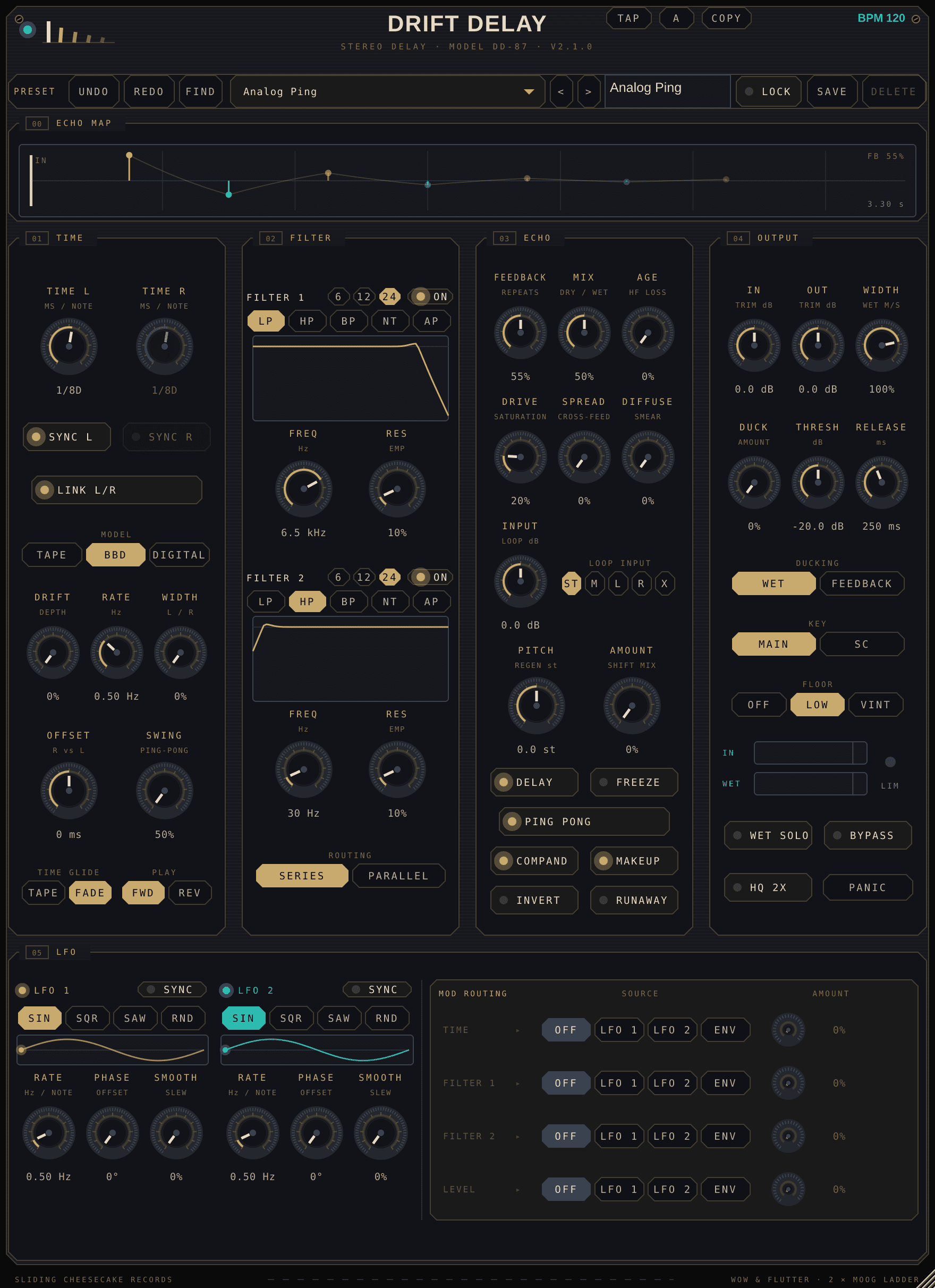
The complete Drift Delay window
Fig. 01The "Analog Ping" preset: a tempo-synced bucket-brigade ping-pong. The Echo Map shows the delay pattern.

ListenDry / wet, same take, rendered through the plugin

Drums, 120 BPM

Preset

Sixteenth Shuffle

Sixteenth-note repeats bouncing left and right, 40 % feedback.

Drums, filters in the loop

Preset

Square Wobble

Eighth-note repeats; a square LFO at a dotted quarter flips the low-pass between two cutoffs.

Guitar, 120 BPM

Preset

Tape Echo

300 ms, 45 % feedback, drive half up. Every repeat passes through the drive and both filters again, so the top end rounds off pass by pass.

Kick, 120 BPM

Preset

Techno Rumble

Short, driven repeats at 88 % Feedback and 50 % Mix, low-passed and ducked under each kick. Use 100 % Mix on a send.

Electric piano

Preset

Ping-Pong

420 ms alternating left and right, 55 % feedback.

Clean guitar

Preset

Rockabilly Slap

120 ms, 22 % feedback, drive at 45 %.

String synth

Preset

Infinite Pad

900 ms ping-pong at 90 % feedback.

Polysynth chords, mono source

Preset

Stereo Sweep

Parallel filters, one per side, each swept by its own LFO half a cycle apart.

Synth arp, mono source

Preset

Haas Widener

10 ms left and 28 ms right, with no feedback or filtering.

Synth arp, in time

Preset

Dotted Eighth

Dotted eighths at 375 ms, or three sixteenth notes, with 50 % Feedback through Digital. Both sides use the same time.

Electric bass

Preset

Doubler

28 ms left, 44 ms right, no feedback.

Voice

Preset

Vocal Thickener

60 ms, the sides 9 ms apart, ducked under the voice.

Organ chord

Preset

Dub Delay

375 ms, 65 % feedback, drive at 35 %, low-pass at 2.8 kHz.

Funk bass, delay switched out

Preset

Drive Box

No delay: drive at 85 % into the filters, fully wet.

Reverse delay

Preset

Reverse Throw

Dotted-eighth reverse delay with feedback ducking. Listen for the backwards vocal in the gaps between phrases.

Shimmer

Preset

Shimmer

+12 semitones per pass at 72 % feedback: each repeat climbs an octave, diffused into a wash and ducked a little under the playing.

Compander and loop controls

Preset

Ducked Feedback

Dotted-eighth repeats at 72 % Feedback, with ducking applied to regeneration.

Sound and controls

Tape, BBD and digital

Three delay models · drive · compander · diffusion

Tape darkens each repeat and adds a low-frequency bump. BBD gets darker as delay time increases. Digital keeps the delay line clean. Drive adds saturation inside the feedback loop, Age adds further high-frequency loss, and Diffuse softens the attacks for denser tails.

Filters in the feedback loop

Two filters · five modes · series or parallel

Each repeat passes through the filters again. Low-pass and high-pass offer 6, 12 and 24 dB/octave slopes; band-pass, notch and all-pass add narrower filtering and phase effects. Use Series to apply both filters to both channels, or Parallel to filter left and right separately. High resonance can produce self-oscillation.

Reverse and pitch shifting

Reverse playback · ±12 semitones per feedback pass

Reverse plays each delay segment backwards. Repeats alternate direction as the loop records its own output. The pitch shifter affects feedback only, leaving the first echo at its original pitch. Set +12 for rising octaves, +7 for fifths, or a small offset for detuning. Amount blends shifted and unshifted feedback. Shifted repeats arrive slightly later because of the pitch processing.

Timing and modulation

Tap tempo · swing · two LFOs · envelope follower

Set left and right delay times independently, link them, sync them to the host or tap a tempo. Swing adjusts the ping-pong rhythm. Tape glide bends pitch during time changes; Fade crossfades between times. Route either LFO or the envelope follower to delay time, either filter or wet level. Synced LFOs follow the host transport.

Ducking and sidechain

Duck the wet output or the feedback

Wet ducking lowers the echoes while you play. Feedback ducking reduces regeneration while leaving the first echo at full level. Set Threshold and Release to suit the part. The envelope can follow the main input or an external sidechain, so another track can control ducking and modulation. Route the sidechain in your host before selecting SC.

Loop colour and level

Separate loop input gain · makeup · selectable noise floor

Input adds gain to the delay loop while leaving the dry signal alone; Makeup compensates at the wet output. Tape and BBD use a paired compressor and expander to control the level entering the delay. The recorded gain is removed on playback to preserve the feedback decay. Floor adds low or vintage hiss, and Invert reverses feedback polarity for different cancellation patterns on short delays.

Working with Drift

Find and compare presets

Search the 76 factory presets by name or category, and star favourites for later. A/B stores two sets of settings with your project; Copy duplicates the current set into the other slot.

Keep send levels fixed

Lock preserves Mix, input and output trims, and Wet Solo during preset changes and A/B comparisons. It keeps a fully wet send fully wet while you browse.

Hold or extend a tail

Click Freeze to latch it, or press and hold for a temporary freeze. Hold Runaway to force feedback above 100%. Panic clears the delay and feedback state.

Control the stereo image

Spread adjusts cross-feedback, Offset shifts the right delay by up to 30 ms, and Width narrows or widens the wet signal. Ping Pong alternates repeats between channels.

Use the filters on their own

Switch Delay off to process the input through drive and the filters without echoes. The modulation matrix can still move the filter cutoffs.

Bypass and quality

Bypass stops new audio entering the loop and lets the existing tail finish. HQ runs the loop at twice the sample rate to reduce aliasing, with extra CPU cost and latency reported to the host.

Front panel

The ECHO MAP display

The Echo Map shows the current delay times, repeat levels and feedback paths. Left and right repeats appear above and below the centre line. Markers indicate reverse playback, pitch shifting and inverted feedback; a beat grid appears when a control is tempo-synced.

The TIME panel

Time

  • Time L / R: 10 ms – 2 s or a note value (1/32T … 2/1) when Sync is on. Link makes R follow L.
  • Model: Tape, BBD or Digital.
  • Drift, Rate and Width; Offset nudges the right side by ±30 ms.
  • Time Glide: Tape (pitch-bend) or Fade (clean crossfade).
  • Play: forwards, or reverse — the repeats alternate direction as the loop re-records.
The FILTER panel

Filter

  • Two ladder slots inside the feedback loop.
  • LP / HP / BP / notch / all-pass, with a 6, 12 or 24 dB per octave slope for LP and HP.
  • Resonance emphasizes the cutoff and reaches self-oscillation at high settings.
  • Series (both channels through 1 then 2) or Parallel (L → 1, R → 2).
The ECHO panel

Echo

  • Feedback to 110 %; past 100 % the loop saturates and holds.
  • Drive into the clipper; Age for extra top-end loss per repeat.
  • Input drives the loop only (±24 dB), and Loop Input picks what feeds it: stereo, mono, one side, or the sides swapped.
  • Compand enables compression and expansion; Makeup compensates loop input gain; Invert flips feedback polarity.
  • Pitch: ±12 semitones on the regeneration only, with Amount to blend shifted and unshifted feedback.
  • Spread, Diffuse, Ping Pong, Freeze; Runaway forces the loop past unity while held; Delay off applies drive and filters without echoes.
The OUTPUT panel

Output

  • In / Out trims; Width (mid/side on the wet path).
  • Duck, Threshold and Release — applied to the wet output or feedback.
  • Key: the duck and the ENV source listen to the main input or an external sidechain.
  • Floor: the medium's hiss, off, low or vintage.
  • IN / WET meters and a LIM lamp; Wet Solo, Bypass (tail rings out), HQ 2×, and Panic to clear a runaway loop.
The LFO section and routing matrix

Each LFO has sine, square, saw and sample-and-hold shapes, with Phase and Smooth controls. The matrix selects a source and amount for each destination. Type values directly into the readouts, double-click to reset a knob, or use Undo and Redo to compare edits. The window is resizable. Read the manual for control ranges and setup instructions.

Presets76 factory presets · save your own

  • Basics4
  • Slapback & Doubling7
  • Rhythmic12
  • Tape9
  • Bucket Brigade6
  • Ambient9
  • Shimmer5
  • Modulated10
  • Filtered7
  • FX7

Presets carry their name into your session and show a * once you've moved away from them. User presets are plain XML files you can share.

Specifications

Formats
VST3, AU, CLAP, Standalone (macOS) · VST3, CLAP, Standalone (Windows)
macOS
11 or later, Apple silicon and Intel (universal)
Windows
10 or later, 64-bit
Delay
10 ms – 2 s free, 1/32T – 2/1 synced (to 5 s); ±30 ms L/R offset; forwards or reverse
Filters
2 resonant transistor ladders · LP / HP at 6, 12 or 24 dB/oct, band-pass, notch, all-pass · series or parallel
Modulation
2 LFOs (sine / square / saw / S&H, free or transport-locked) + envelope follower → time, filter 1, filter 2, wet level
Colour loop
Per-model compander that leaves the decay rate to the Feedback knob, selectable noise floor, ±24 dB loop drive with makeup, feedback invert, input routing
In the loop
Pitch shifter, ±12 st continuous on the regeneration only, with blend; runaway feedback on a spring-loaded switch
Sidechain
External stereo key input for ducking and the envelope follower; falls back to the main input
Sample rates
44.1 – 192 kHz; HQ mode processes at 2×
Latency
0 samples (a few samples in HQ mode, reported to the host)
Price
Free

Changeloglatest · 1.0.0

1.0.0 Sep 2026

  • First public release.
  • Tape, BBD and Digital models; two resonant filters inside the feedback loop; reverse playback and pitch-shifted regeneration.
  • Two LFOs, an envelope follower and an external sidechain input through a modulation matrix.
  • 76 factory presets, with search, favourites, A/B comparison and a Mix/trim lock.

Full changelog →