Acid synthesiser, Model AG-78, v0.2.0
Agena
Acid monosynth and step sequencer
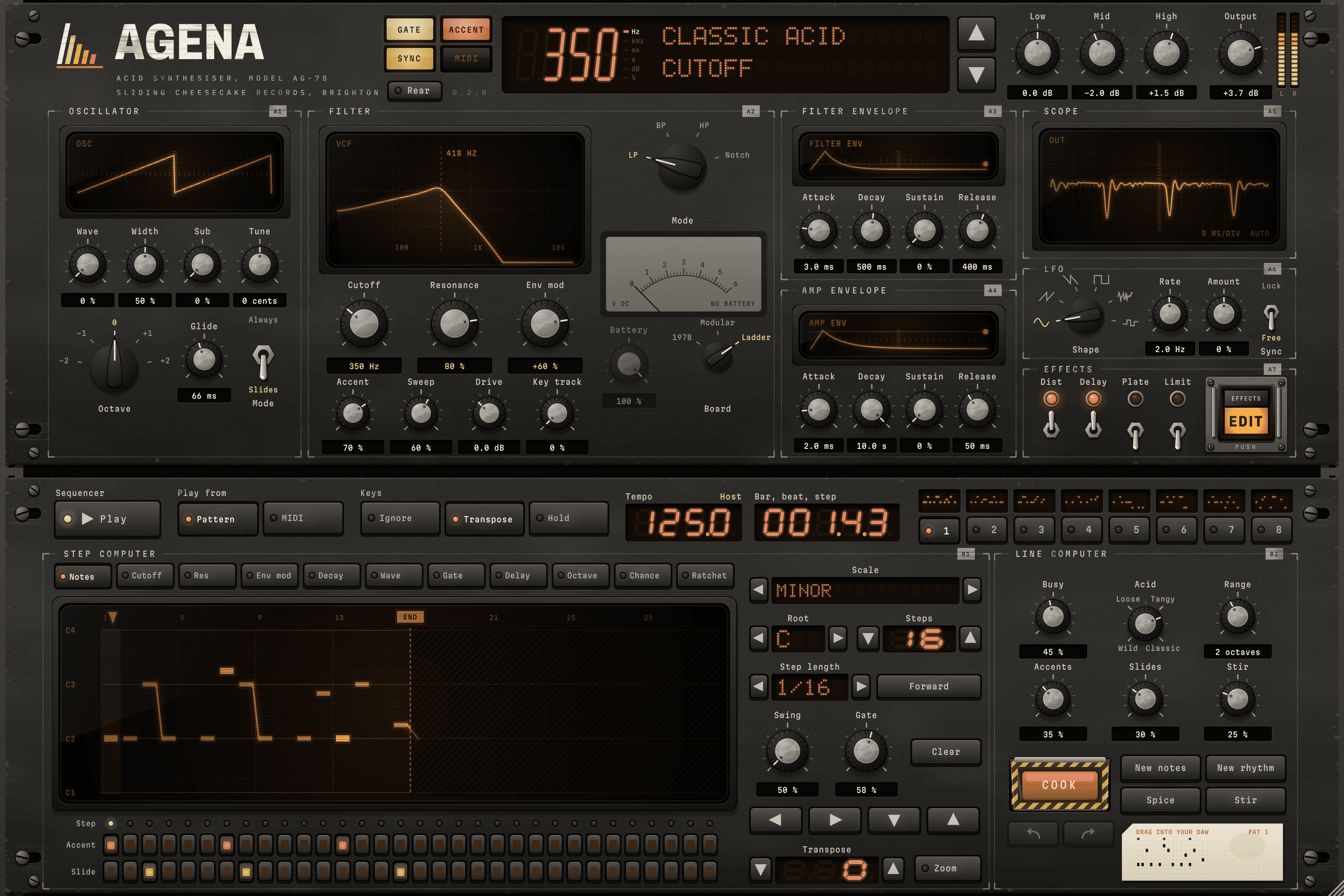
Agena is a monosynth for acid lines. It plays through a diode ladder, or through a model of the filter in a battery-powered British synth from 1978, which used logic chips as its amplifiers. A 32-step sequencer with accent and slide plays it, and nine distortion models, a delay, a plate reverb, an EQ and a limiter come after it.
Listen25 presets on four of the factory patterns, at 125 BPM
Preset
Classic Acid
The Ladder board, with Overdrive blended in at 45 % and a low-passed delay.
Preset
Rubber Duck
Band pass, with a ramp LFO on the cutoff, a quarter note long.
Preset
Basement
Cutoff at 150 Hz on the Ladder board, with the Amp model at 50 % Mix.
Preset
Dub Plate
The 1978 board through Tape, band-passed echoes at 70 % feedback, and the plate.
Preset
Bell Keys
Band pass at 2 kHz, high-passed echoes and the plate.
Each clip is a factory preset playing one of the factory patterns, rendered by a test build of the plugin and left at the level the preset plays at. Pick another preset while a clip plays and it comes in on the same beat.
The voicefilter, oscillator, envelopes, scope, LFO
The filter
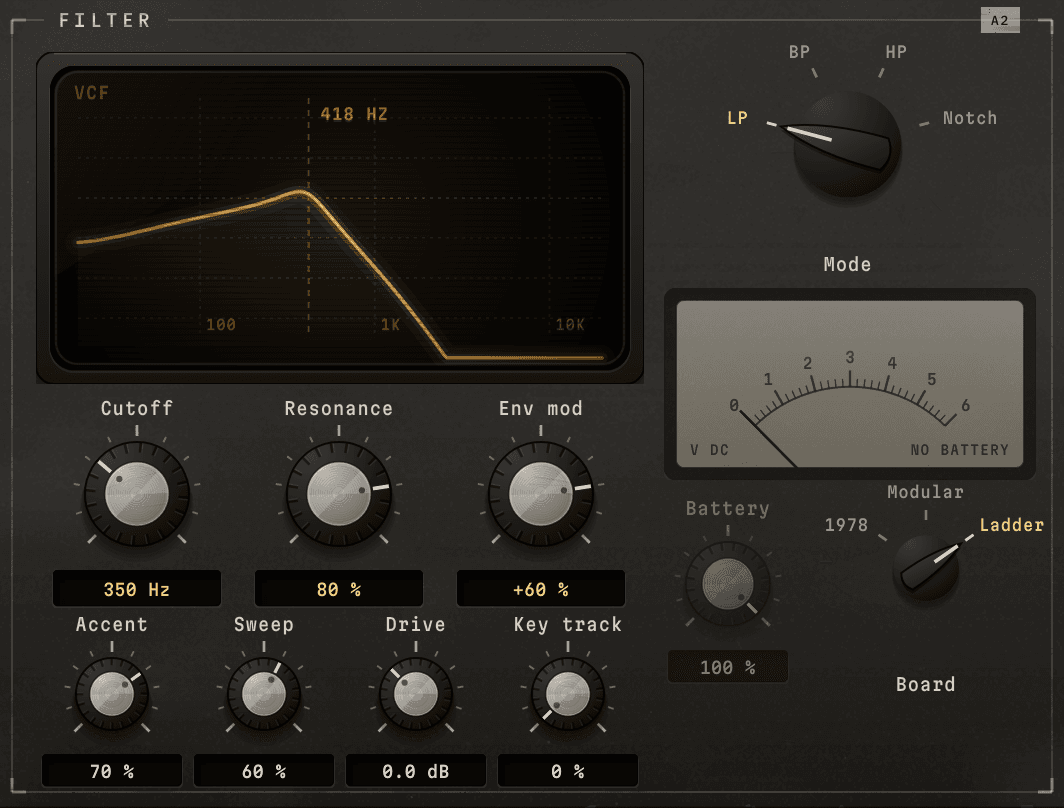
Low pass, band pass, high pass or notch, on three boards
The filter comes from a battery-powered British synth of 1978. Its designer used CD4069 chips, digital inverters made for logic circuits, as the filter's amplifiers, and Agena models that filter part by part, on the original 5 V board or the later 12 V modular one. The third board, Ladder, is a four-pole diode ladder built part by part from a bass synth's service notes, with the couplings around it, its way into the amp, its pulse and its Env mod, and it is where a new instance starts. Drive sets how hard the oscillator hits the filter. Drag across the screen to set Cutoff and Resonance.
The oscillator
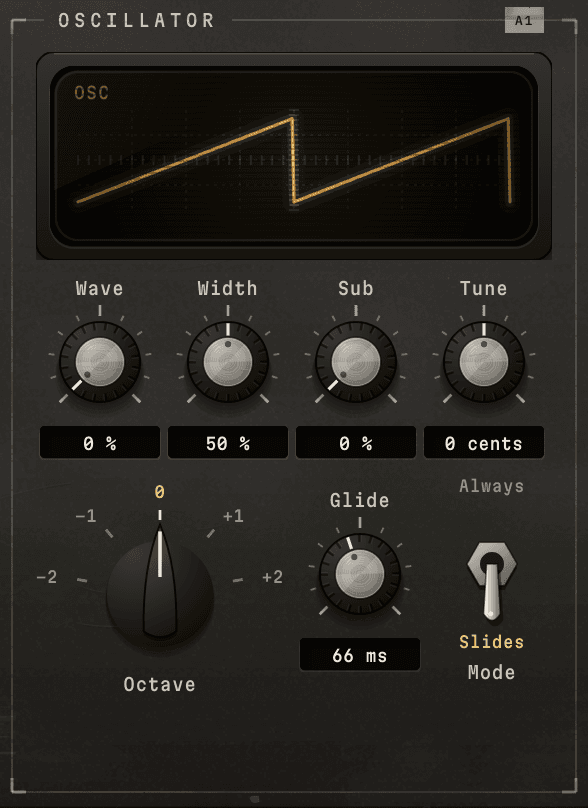
Sawtooth to pulse, with a sub
Wave blends a sawtooth into a pulse, and Width sets the pulse's width. On the 1978 and modular boards 50 % is a square. On the Ladder board a single transistor shapes the pulse from the sawtooth, as the circuit it follows does, so it narrows as notes rise: with Width at 50 %, it is high for about 61 % of each cycle at 35 Hz and 41 % at 200 Hz. Sub adds a square an octave down, locked to the oscillator. The sawtooth, and the pulse on the other two boards, stay clean on high notes. The Ladder board's pulse switches fast enough to alias a little: before the filter, the loudest alias below 20 kHz is 61 dB under the note at C4 and 47 dB under it at 1 kHz. Glide sets how long a slide takes, the same for any interval, and starts at 66 ms.
Envelopes and accent
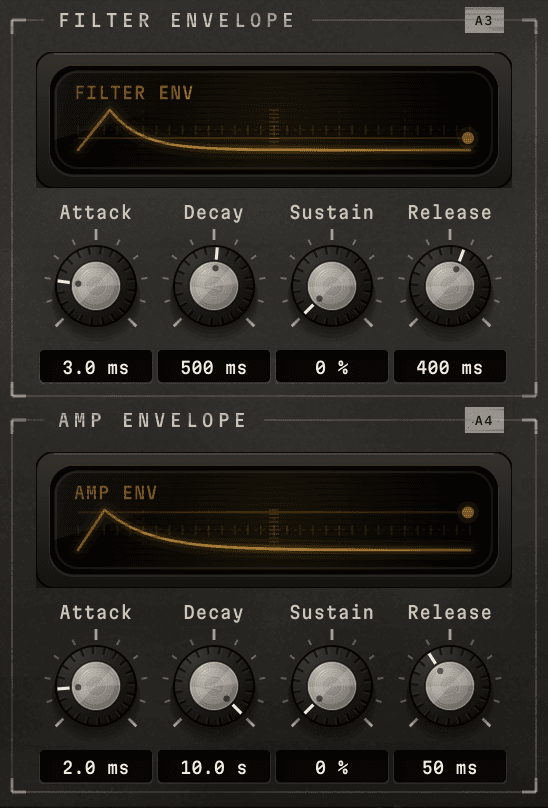
Two envelopes, each with its own screen
The filter and the amp each have an ADSR, drawn on its own screen with a dot where it is now. An accented note starts louder, by up to 8 dB with Accent at full. Sweep sets how an accent moves the cutoff: low, a sharp blip; turned up, a swell through the note, and accents close together climb higher.
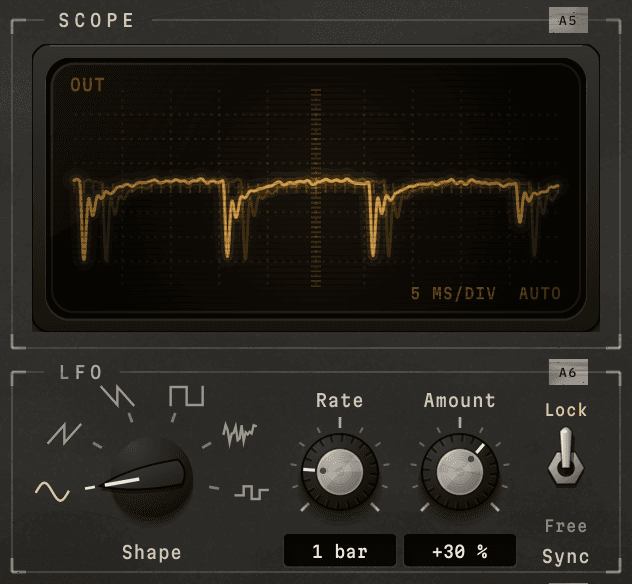
The scope and the LFO
Six shapes, free or in time
The scope shows the output as it plays. The LFO moves the cutoff, up to four octaves either way, with a sine, ramp, sawtooth, square, noise or random shape. Free, it runs from one cycle every 20 seconds to 100 Hz; locked to your host, from four bars to a thirty-second note.
The effectsdistortion, delay, plate, EQ, limiter
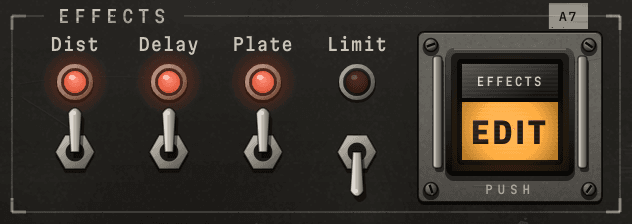
The distortion, the delay, the plate and the limiter each have a switch on the front, under a lamp that is lit while it is on. Switched off, the delay and the plate fade out over 10 ms, and the distortion eases out as it does when its Drive is turned down. In order, the chain runs distortion, delay, plate, EQ, Output and limiter.
Edit opens the effects out over the voice unit, a page for each behind a tab, with all their controls. Each tab has a lamp, lit while its effect is on: click the lamp to switch the effect on or off from any page, or the rest of the tab to open its page. The presets, the EQ, Output and the sequencer stay in reach.
Beside the tabs are the effects' own presets: Dry and 31 chains of two effects or more. Each sets the four pages and nothing else, so the EQ and Output stay as they are. Lock keeps the effects as they are while you try other sounds through them.
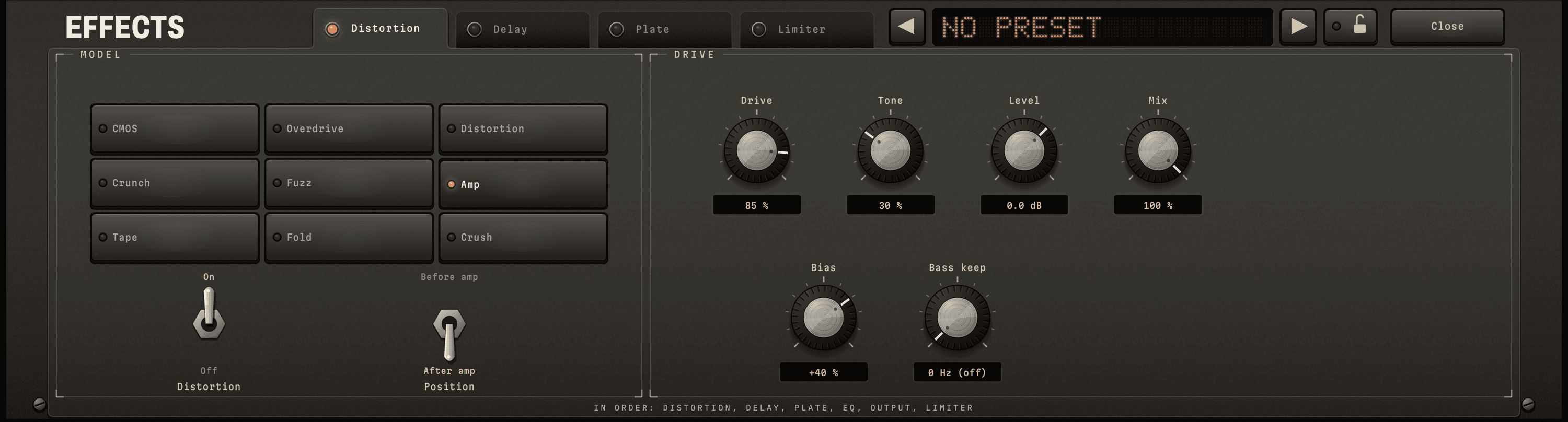
Distortion
Nine models. CMOS is the fuzz Agena started with, a CD4069 inverter wired as a fuzz. Overdrive clips softly and keeps the clean signal in. Distortion is an op-amp distortion with up to 67 dB of gain into silicon diodes. Crunch is a booster and an op-amp into diodes, with a scooped tone. Fuzz has two clipping stages and a scoop around 1 kHz. Amp is two triode stages, sag and a 4x12 cabinet. Tape saturates between pre- and de-emphasis, Fold is a wavefolder, and Crush takes away bits and rate.
Each has Drive, Tone, Level and Mix. Bias moves the clipping off centre for even harmonics. Bass keep sends everything under its frequency round the distortion clean, through a crossover that adds back up flat, so the bass line keeps its weight. Position puts the distortion after the amp, as a pedal after the synth would be, or before it, so the grit stays the same through each note's fall.
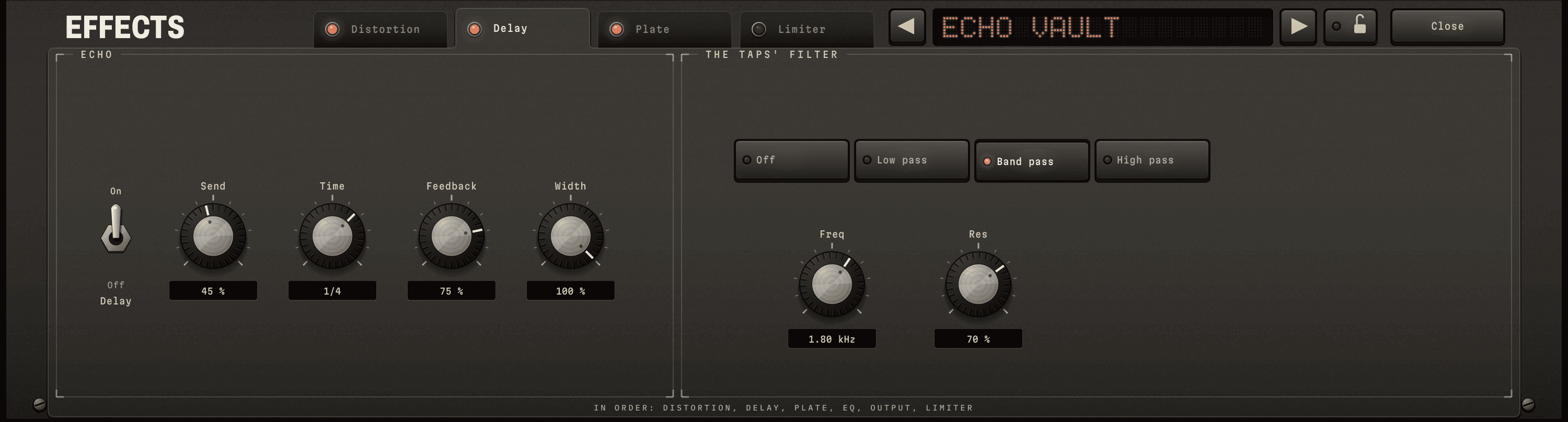
Delay
A ping-pong delay at a note value of your tempo, from a sixteenth to a half note, with dotted values and an eighth-note triplet. Each repeat loses a little top and bottom and is gently saturated, so long feedback darkens as it goes. Width narrows the bounce towards the middle. The Delay lane in the sequencer sends single steps into it.
The taps' filter is a resonant low, band or high pass where the echoes are written, so the first echo goes through it once and each repeat once more. However high the resonance, the echoes never build up: each mode is scaled so its peak stays at unity, and more resonance narrows what comes round.
Plate
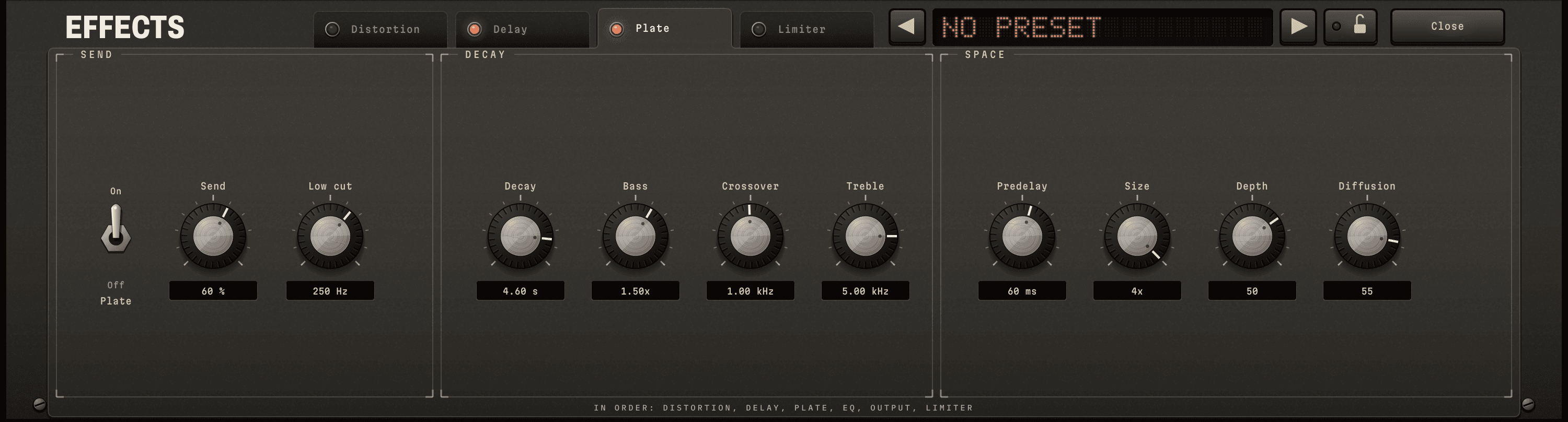
The Drum Plate from our Mantissa reverb, in its 1978 voice, on a send after the echoes. Decay runs from 0.6 to 6.5 s, and Bass, Crossover and Treble shape how the tail falls, as Mantissa's faders do.
Low cut keeps the bass out of the plate, from 150 Hz to start. Predelay holds the start back by up to 107 ms, Size scales the plate from half to four times, and Depth and Diffusion set how far away it sounds and how dense its start is.
Limiter
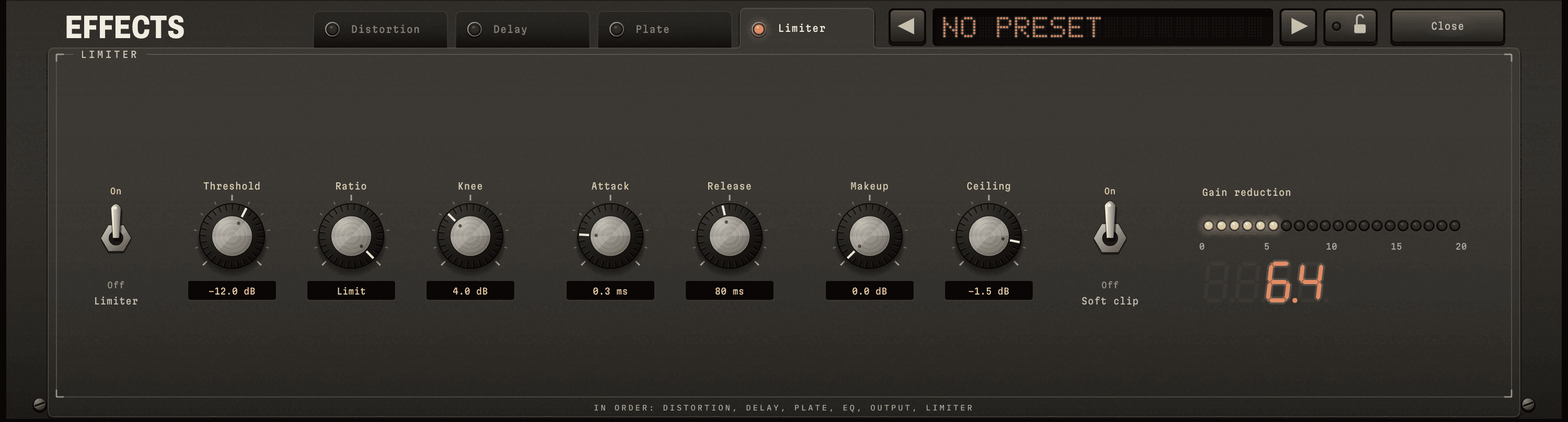
Last in the chain, after the EQ and Output, with Threshold, Ratio up to Limit, Knee, Attack, Release, Makeup and a Ceiling. Soft clip leaves everything up to 6 dB under the ceiling as it is and bends what is over it round into the ceiling. A row of lamps shows the gain reduction, 1 dB each up to 20 dB.
The step computer32 steps, 8 patterns
Notes, accents and slides
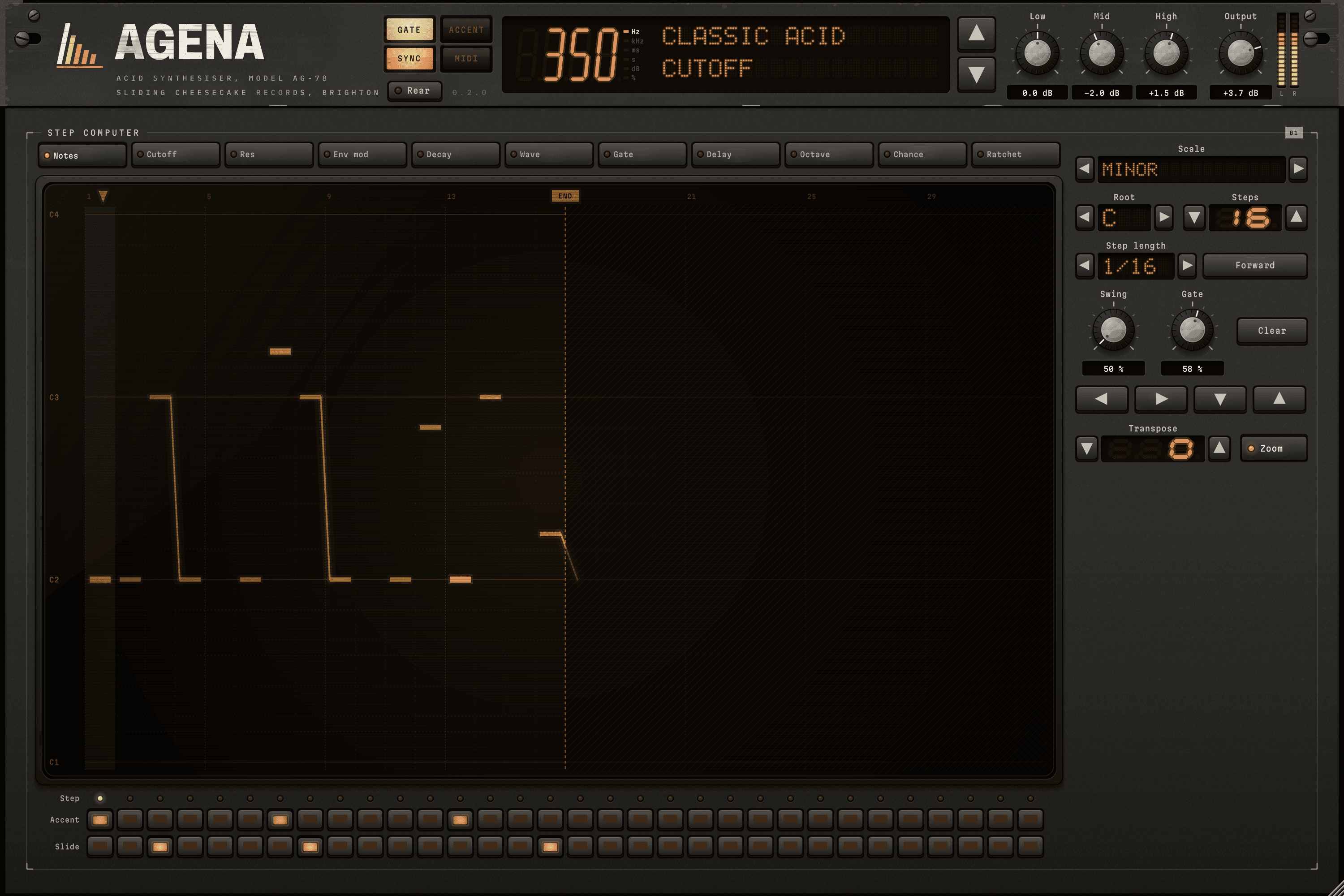
Click a step to place a note, or drag to draw a line. The lamp keys under the screen set accents and slides. Notes snap to the scale you pick, and changing the scale moves only the notes that fall outside the new one.
Ten lanes, each its own length
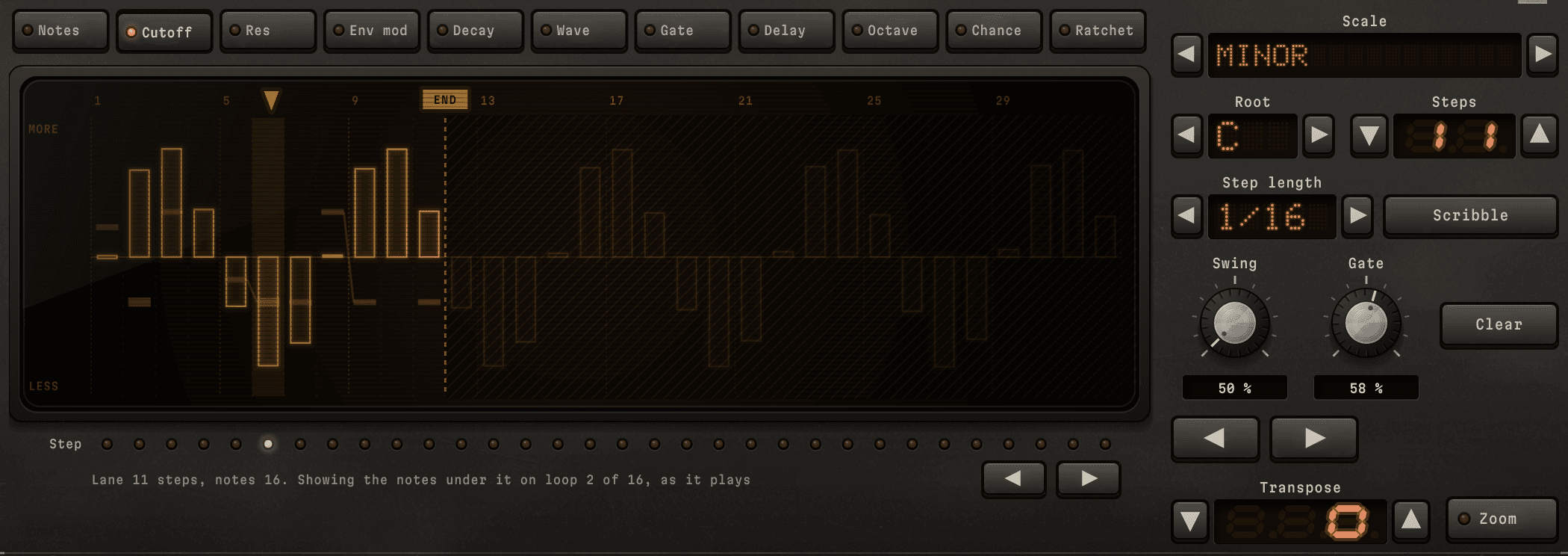
Seven lanes change the sound on each step: cutoff, resonance, env mod, decay, wave, gate and the delay send. Octave, Chance and Ratchet change the steps. A lane shorter than the notes drifts against them, and the line changes shape from bar to bar.
In time with your host
Steps are placed on the host's beat, and a pattern always lines up with the bars. Chance skips steps at random, but the same point in the song always rolls the same way, and a bounce matches what you heard on playback.
Play it from the keys
With Keys on Transpose, the last key you hold moves the line. Hold does the same, and plays the line only while you hold a key. Set Play from to MIDI to play the voice yourself. Overlapping notes slide, and a velocity of 100 or more plays an accent.
The line computer
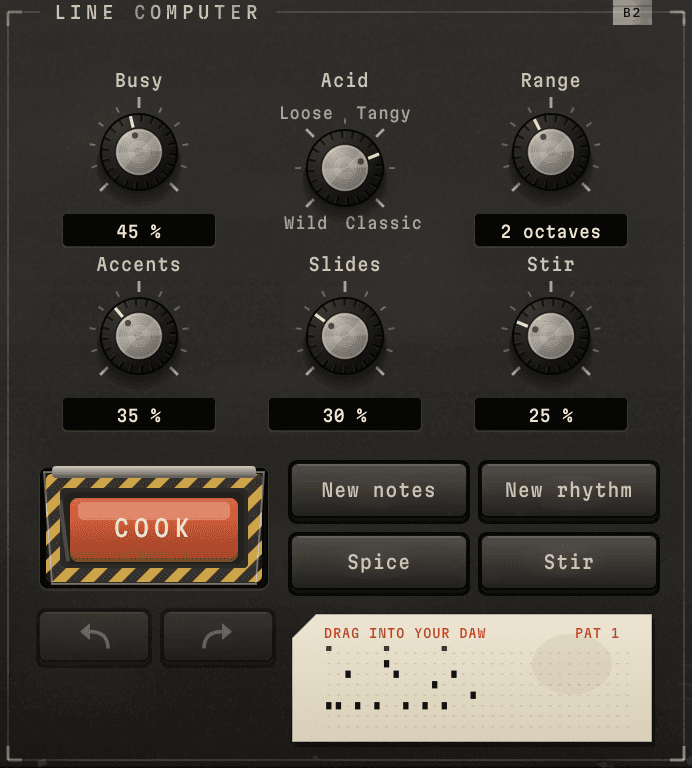
Press Cook for a new line; its guard swings up as the pointer comes near. Acid sets how it is phrased. At Classic it uses a few pitches, mostly the root and its octave, with a fifth, minor third, flat seventh or flat second for colour; at Wild the intervals are free. Busy, Accents and Slides set how many of each a bar gets. Acid lines usually have six to ten notes a bar, with two or three accents.
New notes keeps the rhythm and New rhythm keeps the notes. Spice redraws the accents, slides and octaves, and Stir changes a few steps. Undo brings back the previous line.
Drag the punched card into your DAW to take the pattern as MIDI. Slides become overlapping notes and accents full velocity. Played back with Play from on MIDI and Transpose at 0, the clip sounds like the pattern, except that a slide from the last step into the first starts a fresh note.
The EQlow shelf, bell, high shelf
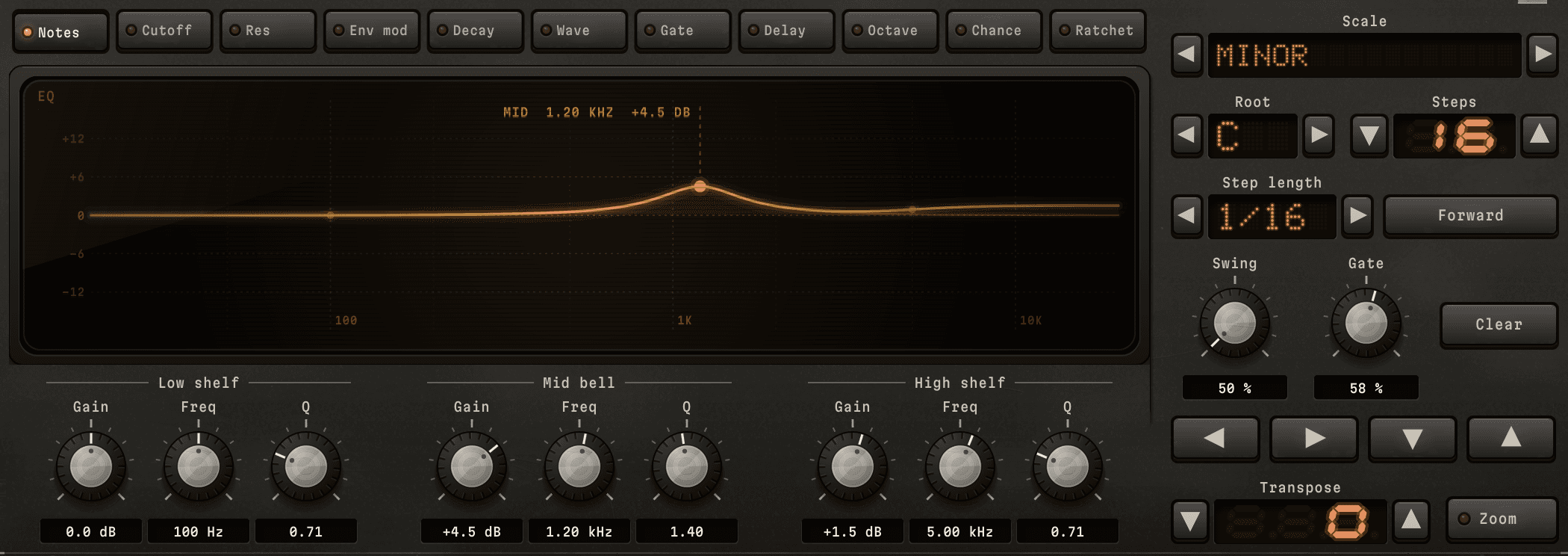
A low shelf, a bell and a high shelf come after the plate and before Output, each with ±12 dB and its own frequency and Q. Turn an EQ knob and the curve comes up over the step computer. The sequencer comes back a moment after you let go.
The EQ adds no latency, and moving or automating a band doesn't click. With all three gains at 0 dB it leaves the sound untouched. Beside Output, a meter shows the peaks leaving the plugin, left and right, with a red light at the top that stays lit after a sample reaches full scale, until you click it.
Board and battery
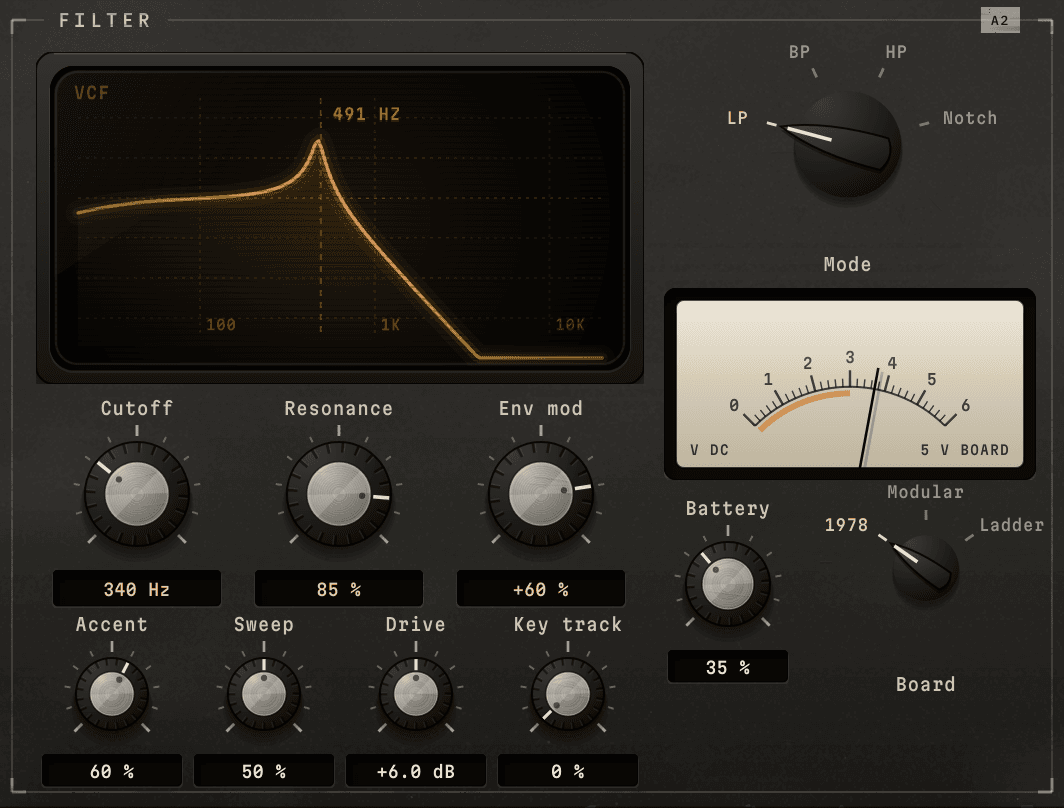
Board picks the filter. The 1978 board runs on 5 V, as the original synth did. The modular board is the later 12 V version of the same circuit, with more headroom and so little damping in its resonance that Resonance at full turns its pot only 62.5 % of the way. The Ladder board is the diode ladder, with the pulse, Env mod and way into the amp of the circuit it follows.
On the 1978 and modular boards, Battery lowers the supply to as little as 60 %, as a battery running down did in the original, and the meter shows it. As it drops, the filter has less headroom and distorts sooner. The Ladder board runs on no battery.
The rear paneleight trimmers
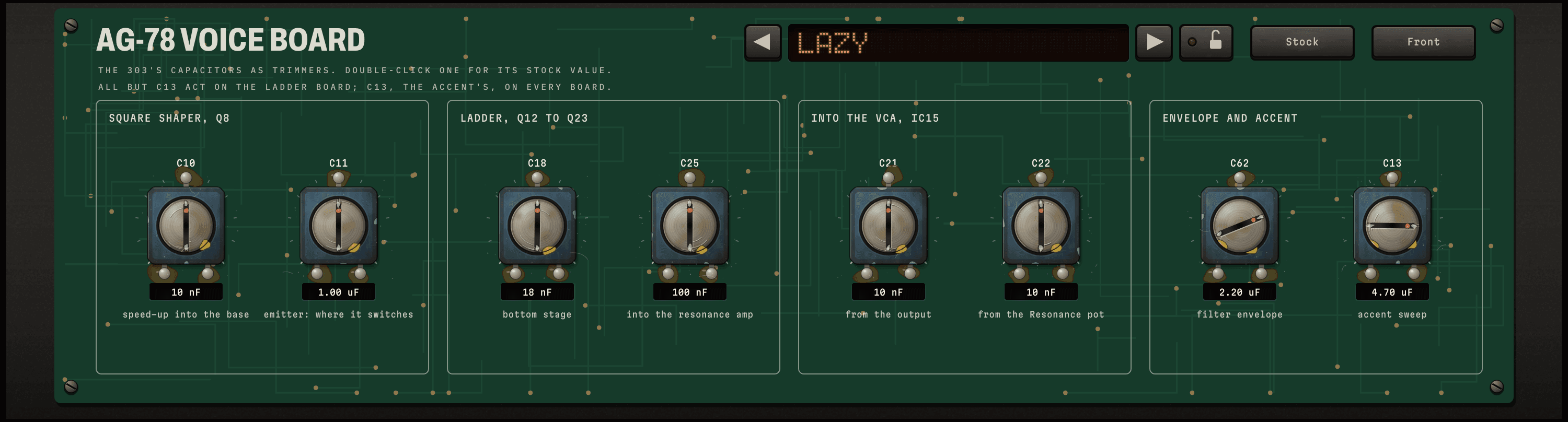
Rear turns the voice unit round to its board, where eight trimmers set capacitors in the Ladder board's circuit: two shape its pulse, two its ladder and resonance, two the way into the amp, one sets the filter envelope's length and one the accent's sweep. The accent's works on every board, the rest on the Ladder board. Stock puts them all back.
The board has 13 presets of its own, named for what they do, such as Short Envelope, More Bass and Steady Square. Each changes the trimmers and nothing else, and Lock keeps them as they are while you change sounds.
Presets100 factory presets, plus your own
- Basics12
- Squelch20
- Deep14
- Space16
- Grit12
- Odd14
- Keys12
Presets change the sound only. Your patterns and sequencer settings stay with the session when you change preset. Most presets use the effects: 69 a distortion model, 37 the delay and 58 the plate. The effects panel and the rear panel have presets of their own as well, 32 and 13, and you can save your own of each.
Specifications
- Formats
- VST3, AU and Standalone
- Filter
- A diode ladder, or a model of a 1978 CMOS filter on its original 5 V board or the 12 V modular one; low pass, band pass, high pass or notch
- Oscillator
- Sawtooth to pulse with a sub an octave down; band-limited, apart from the Ladder board's transistor-shaped pulse
- Sequencer
- Up to 32 steps and eight patterns, ten lanes with their own lengths, swing, a scale and four play directions
- Distortion
- Nine models, with Drive, Tone, Level, Mix, Bias, Bass keep, and Position after or before the amp
- Delay
- Ping-pong at note values of the tempo, with a resonant low, band or high pass on its taps and Width
- Plate
- Mantissa's Drum Plate on a send after the delay, decay from 0.6 to 6.5 s, with the program's own controls
- EQ
- Low shelf from 20 to 500 Hz, bell from 100 Hz to 10 kHz, high shelf from 1 to 16 kHz, each ±12 dB, no latency
- Limiter
- Threshold, ratio up to Limit, knee, attack, release, makeup, ceiling and soft clip, last in the chain
- Rear panel
- Eight trimmers for the Ladder board's capacitors (the accent's works on every board), with 13 presets of their own
- Metering
- Output peaks, left and right, from -48 dB to full scale, with a clip light
- MIDI
- Play the voice from MIDI, transpose the line from the keys, pick patterns with notes 0 to 7, drag a pattern out as MIDI
- Price
- To be announced