Mantissa, Model MT-78

Mantissa and the original


The reverb Mantissa is modelled on was first shown in 1978. It was a four-rack-unit box of circuit cards with a separate remote of faders and buttons, and it cost $7,500 with two programs. Its designer never patented the algorithms. They were kept as a trade secret, and the 1978 networks have never been published.

So Mantissa is a reconstruction. We started from the 1980 service manual, which describes every card, and from papers that publish networks in the designer's style. We built the structure they describe, then fitted it to measurements, program by program.
Card by cardThe original's mainframe, and ours

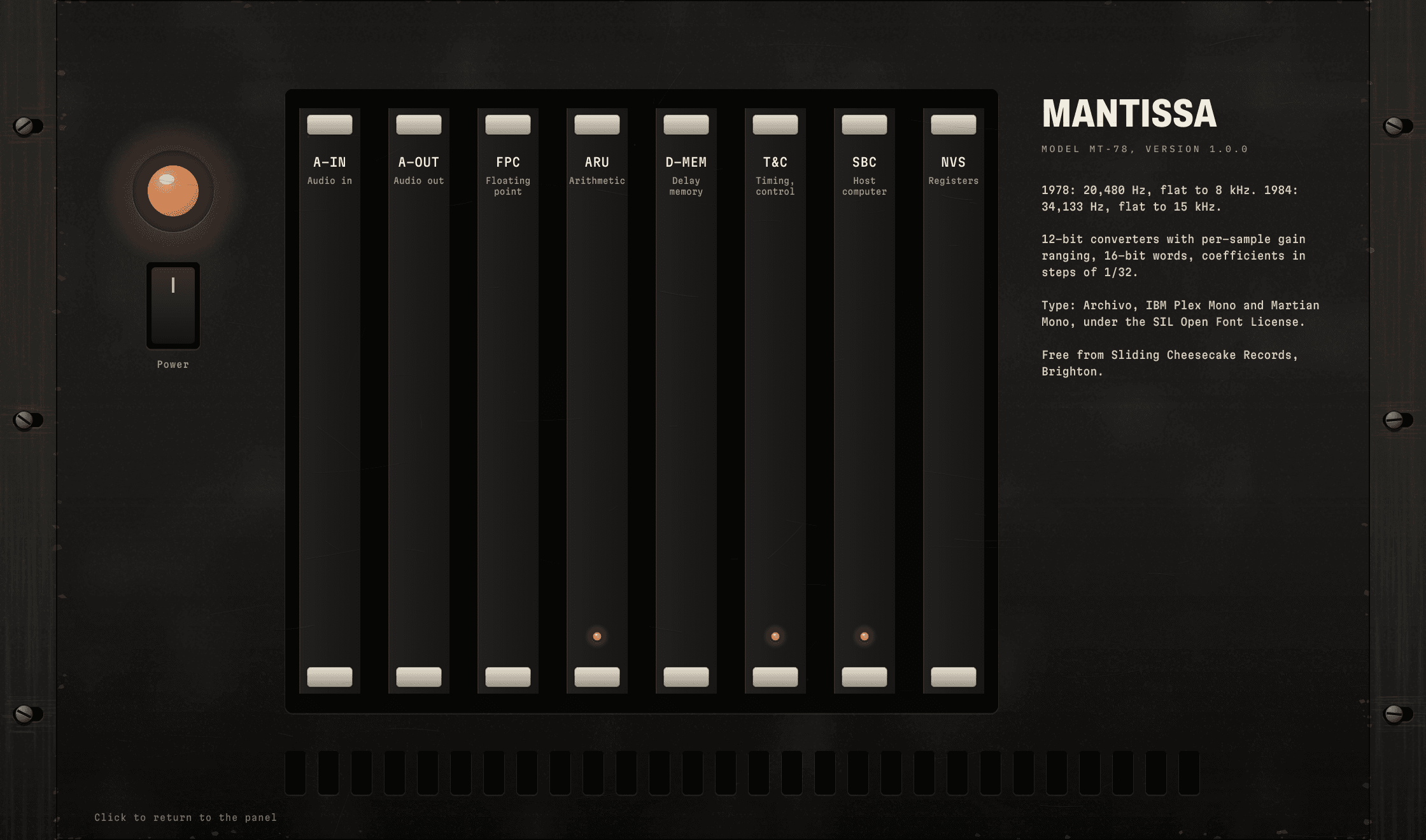
The Mantissa mainframe view: eight circuit cards named after the original's, a power lamp and switch, and the version
Fig. 01 Click the name on Mantissa's panel for the mainframe view. The cards carry the original's names.

A-IN

Audio in

The original

Transformer-coupled inputs with 15 dB of trim, a 7-pole elliptic low-pass at 8 kHz, a pre-emphasis shelf (2.6 dB up at 2 kHz, 8.15 dB at 8 kHz), and a gain ranger that picks 0, 6, 12 or 18 dB of gain before each sample. Left and right are sampled 25 µs apart through one converter.

Mantissa

A transformer model you can push with Drive, the same pre-emphasis as a first-order shelf, and a windowed-sinc filter down to the engine rate, 6 dB down at 8.75 kHz. The gain is chosen per sample at the original's thresholds: 45 %, 22.4 % and 11.2 % of full scale. Both channels are sampled at the same instant.

FPC

Floating point

The original

Turns the 12-bit sample and its two gain bits into a 16-bit word by shifting it left 4, 3, 2 or 1 places, and back again on the way out.

Mantissa

The same shifts, both ways. Mantissa takes its name from this card's 12-bit mantissa.

ARU

Arithmetic

The original

One multiply and add per step, with 16-bit data, coefficients in steps of 1/32 and a saturating accumulator. Allpasses built as three-multiplier lattices. (Traced on the later hardware, whose arithmetic card is the same design.)

Mantissa

Delay memory that clips where a 16-bit word would and lights Ovfl, diffusion gains in 1/32 steps with Stepped on, and the same three-multiplier allpasses. Inside the reverb loops their normalisers stay exact, where the original rounded them to 1/32; with them rounded, some long Bass settings slowly ran away in ours. Unlike the original, our loops also keep their lowest bits. Truncating them left a faint hum, 82 to 89 dB down, after every sound, which the reference doesn't have.

D-MEM

Delay memory

The original

16,384 words of 16 bits, about 0.8 s of delay in all, shared by every delay in a program.

Mantissa

Enough memory for every network at Size 4x. The 0.8 s limit doesn't apply.

T&C

Timing and control

The original

A 100-step microprogram per sample at about 2 MHz, so a sample rate of about 20 kHz. 20.48 kHz is the figure the evidence points to: a 2.048 MHz clock, and a trimmed notch in the output filter at exactly half that rate.

Mantissa

The engine runs at 20,480 Hz, or 34,133 Hz in the 1984 era, whatever your session's rate.

SBC

Host computer

The original

An 8080 that read the faders as 8-bit values. Its display values fit coefficients in steps of 1/32, so each decay and filter fader had 31 settings. On the later hardware it moved the Mode Enhancement taps about a thousand times a second in random directions.

Mantissa

Stepped snaps the four decay and filter faders to the original's 31 values. Mode Enhancement is a random walk at a constant speed, updated at a control rate.

A-OUT

Audio out

The original

One 12-bit converter shared by four outputs, then an attenuator of 1, 1/2, 1/4 or 1/8, a sample-and-hold for each output, de-emphasis, 7-pole reconstruction filters and output transformers.

Mantissa

The same gain ranging on the way out, except that ours rounds to the nearest step where the original dropped the low bits. Then a sinc filter back to your session's rate, de-emphasis, and half of a sample-and-hold's droop, the amount that matched the reference. Two of the four outputs at a time, Front or Rear.

NVS

Registers

The original

A later card with battery-backed memory, so the final firmware could store settings in registers.

Mantissa

Eight registers shared by every copy of Mantissa on the computer, plus presets and tape.

The controlsThe original's final firmware, and ours

ControlThe originalMantissa
Bass and Mid Decay0.6 to 70 s each, split at the Crossover, in 31 coarse stepsThe same range, with the original's 31 values when Stepped is on, or continuous
Crossover and Treble Decay100 Hz to 10.9 kHz, one-pole filtersThe same
Depth0 to 71, from close to far (on the later hardware, by crossfading output taps along stored curves)The same range. Ours fades the near taps out in a straight line
Diffusion0 to 63, added in firmware 4.0The same range. How it maps to the internal gains is our estimate
PredelayUp to 255 ms, with a range per program. On the halls the reading includes some of the network's own delayThe same ranges and the same offset, fitted per program: Small Hall starts about 20 ms before the value shown, 23 ms at the top of its range, within a millisecond of the reference. Note values are ours
Mode EnhancementOn or off, Amount 1 to 16, Pitch 1 to 16. Switching it resets the programThe same controls, including the reset. How Amount and Pitch drive the walk is our estimate
Decay OptimisationOn or off, Amount 1 to 16The same controls, with the timing fitted to the reference: the first second of a tail is left alone, then the decay steepens gently
OutputsFour, A to D. A and C are the main pairFront (A and C) or Rear (B and D), and Spread to mix them
DisplayThree seven-segment digits, a headroom ladder and an overflow lamp. In the reference, the readout returns to the reverb time after about 3.5 sThe same, on a wider display that also names the program and the control
MixNone: the outputs were 100 % reverbAn equal-power Mix, with the dry signal kept in time

The programsHow each is built

The final firmware had nine programs on seven networks. Mantissa keeps their order, roles, defaults and predelay ranges, but builds them on four networks: the three halls share one, since their echo timings match in the reference; Room and Chamber are that hall network scaled down; the two plates share one; and Dense Plate and Chorus have their own.

Small Hall, Large Hall, Bright Hall
One hall network: in the reference, all three have the same echo timings, with different defaults and damping. Ours is the figure-eight of nested allpasses in a published drawing whose values match the designer's later concert hall. It runs at 0.75 of the drawing's delay lengths (0.5 on the input side), with decay, level and tone fitted.
Room
The hall network at 0.26 of its delays. The original's room had a network of its own, which hasn't been published.
Chamber
The hall network at 0.72, with a mono input and fixed diffusion, as the original's chamber had. Its own network hasn't been published either.
Vocal Plate, Drum Plate
One plate network, as on the original, with less diffusion in the loop for vocals (0.6) than for drums (0.7). Ours starts from a published plate in the designer's style, with its input diffusers cut to a quarter of their length to match the reference. Some input diffusion stays at Diffusion 0, since the reference stays smooth there.
Dense Plate
A plate with only light, fixed diffusion in a short loop, so it is dense from the first echo and stays that way. Mono input, and no Decay Optimisation, as on the original.
Chorus
Eight voices on random walks, four per side, with Diffusion on voices 3 and 4. The levels are fitted. The timing isn't yet.

Measured

We don't have the hardware. The reference is a commercial software recreation whose maker says it runs the original's program code. A script rendered it 44 times at exact settings, and Mantissa was fitted to those renders program by program: decay time in octave bands, level, tone and the timing of the first echoes.

Every Mantissa number below comes from rendering the plugin and measuring the result with the same scripts each time, so it can be checked and repeated.

Against the reference, program by program

ProgramLevel (dB)RT 125 Hz (s)RT 250 Hz (s)RT 1 kHz (s)RT 4 kHz (s)8 kHz (dB)
Small Hall-11.4/-11.43.30/2.813.24/2.752.50/2.481.86/2.13-6.6/-5.9
Vocal Plate-6.5/-6.52.22/2.492.24/2.312.32/2.332.25/2.27-2.5/-2.4
Large Hall-11.2/-11.23.71/3.423.63/3.433.12/3.152.30/2.47-7.4/-6.8
Chamber-15.1/-15.12.67/2.562.60/2.392.37/2.351.95/2.02-3.1/-3.0
Drum Plate-6.8/-6.82.23/2.352.23/2.272.27/2.292.21/2.22-2.5/-2.5
Bright Hall-9.5/-9.53.40/2.863.24/2.582.44/2.391.98/2.17-2.6/-2.8
Room-9.1/-9.11.95/1.611.96/1.971.91/1.841.44/1.76-3.3/-3.4
Dense Plate-8.9/-8.91.61/1.661.58/1.641.60/1.621.52/1.55-2.5/-2.8

Reference first, ours second, from the same impulses with Mode Enhancement and Decay Optimisation off. Level is the reverb's energy against the input's; RT is the decay time in octave bands; the last column is the level at 8 kHz against 1 kHz. With both switches on, the reference's Mode Enhancement shortens the treble more than ours: Small Hall at 4 kHz measures 1.46 s against our 1.88 s.

The decay faders

Decay time as set against as measured at 1 kHz0.20.51251020500.612510205070Bass and Mid Decay as set (s)Measured (s)
As setSmall HallVocal Plate

Each of the 31 settings, Stepped on, with Mode Enhancement, Decay Optimisation and the noise floor off, as the reference was fitted. Every setting rings longer than the one below it. From 0.8 to 22 s Small Hall measures -17 to +4 % from the setting and Vocal Plate +3 to +17 %; at 70 s they measure 51 and 68 s. Mode Enhancement, on by default, shortens long tails a little further.

Predelay

Predelay as displayed against the first arrival0408012016004080120160Displayed (ms)First arrival (ms)
As displayedSmall HallVocal PlateSmall Hall, reference

On the halls the reading includes part of the network's own delay, as on the original, so Small Hall starts 20 ms before the value shown at the bottom of its range and 23 ms before it at the top, within 0.6 ms of the reference. Vocal Plate starts 0.8 ms after the value shown.

1978, 1984 and Clean

Small Hall's response in each era, 100 % wet0-10-20-30-40501002005001k2k5k10k20kHzdB re 1 kHz
197819841978 with CleanPink noise through Small Hall at its defaults, 100 % wet, in sixth-octave bands. The response is 20 dB down at 9.1 kHz in the 1978 era and 16.1 kHz in the 1984 era. Below 8 kHz the two are within half a decibel, and Clean lies on top of 1978. The gentle slope above 2 kHz is Small Hall's treble damping, the same in all three.

Mode Enhancement

How far a 1 kHz tone's reverb tail spreads0 %25 %50 %75 %100 %0.5125102030Hz either side of 1 kHzShare of the tail beyond
Ours, offOurs, onReference, on

A steady 1 kHz tone, then two seconds of its tail, and how much of the tail lies further than a given distance from 1 kHz. Mode Enhancement's moving delays spread the tail into sidebands. The reference moves more of it a few hertz away: 55 % lies beyond 3 Hz, against 30 % of ours. Ours has a thinner skirt that reaches further out, past 5 Hz.

Decay Optimisation

What Decay Optimisation takes off Small Hall's decay, after a burst of noise0-2-4-6-801234Seconds after the burstOn minus off (dB)
ReferenceMantissa

The capture kit's burst of pink noise through Small Hall, with Mode Enhancement off. The line is the decay curve with Decay Optimisation on, less the same with it off. Both leave the first second and a half alone, then lower the diffusion in the loop so the late tail falls faster. Three seconds after the burst ours is 4.4 dB down and the reference 3.3 dB.

Stop Decay

Vocal Plate at 1.3 s, with and without Stop Decay-20-40-60-80-1000123456Seconds (noise from 0 to 1 s)dBFS
Stop offStop Decay 3.4 s, Hold 150 ms

A second of pink noise, then silence, with the noise floor on as you hear it. Without Stop Decay the tail measures 1.4 s. With it, the decay glides to 3.4 s once the input has been quiet for 150 ms. Both level out at the noise floor.

1978, 1984, Clean and Drive

Small Hall, four ways

Setting

1978

20.48 kHz sampling, about 8 kHz of bandwidth, 12-bit gain-ranging converters.

What Mantissa adds

Mix and the dry path
The hardware was 100 % wet. Mix crossfades at equal power, and the dry signal is delayed to stay in time.
The 1984 era
The later revision's rate and bandwidth, on the same programs.
Clean
The networks without the converters, transformer, 16-bit clipping or noise floor.
Size, Definition, Stop Decay
From the later hardware's controls, applied to the 1978 programs.
Drive, Spread, Output
A level into the converters that comes back off afterwards, a blend of the two output pairs, and a trim.
Stepped as a switch
The original's coarse steps, or continuous values for smooth automation.
Spill
The old program rings on for five seconds after a change.
Presets and note values
56 factory presets, your own presets, and predelay in note values at the host's tempo.

Where it still differs

The next fitting pass works on these. Updates are free, and the manual describes the plugin as it is.

Sources